| |
|
"For People Who Understand"
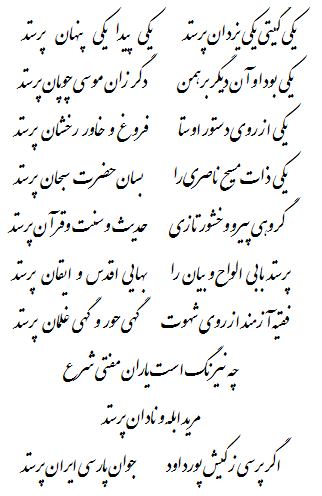
| A page from an eleventh- or
twelfth-century Persian Koran. Courtesy of the Arthur M. Sackler
Museum, Harvard University
Art Museums, Fund for the
Acquisition of Islamic Art.
|
ROUGHLY equivalent in length to the New Testament, the Koran is divided into
114 sections, known as suras, that vary dramatically in length and form.
The book's organizing principle is neither chronological nor thematic -- for the
most part the suras are arranged from beginning to end in descending
order of length. Despite the unusual structure, however, what generally
surprises newcomers to the Koran is the degree to which it draws on the same
beliefs and stories that appear in the Bible. God (Allah in Arabic)
rules supreme: he is the all-powerful, all-knowing, and all-merciful Being who
has created the world and its creatures; he sends messages and laws through
prophets to help guide human existence; and, at a time in the future known only
to him, he will bring about the end of the world and the Day of Judgment. Adam,
the first man, is expelled from Paradise for eating from the forbidden tree.
Noah builds an ark to save a select few from a flood brought on by the wrath of
God. Abraham prepares himself to sacrifice his son at God's bidding. Moses
leads the Israelites out of Egypt and receives a revelation on Mount Sinai.
Jesus -- born of the Virgin Mary and referred to as the Messiah -- works miracles,
has disciples, and rises to heaven.
The Koran takes great care to stress this common monotheistic heritage, but it
works equally hard to distinguish Islam from Judaism and Christianity. For
example, it mentions prophets -- Hud, Salih, Shu'ayb, Luqman, and others -- whose
origins seem exclusively Arabian, and it reminds readers that it is "A Koran in
Arabic, / For people who understand." Despite its repeated assertions to the
contrary, however, the Koran is often extremely difficult for contemporary
readers -- even highly educated speakers of Arabic -- to understand. It sometimes
makes dramatic shifts in style, voice, and subject matter from verse to verse,
and it assumes a familiarity with language, stories, and events that seem to
have been lost even to the earliest of Muslim exegetes (typical of a text that
initially evolved in an oral tradition). Its apparent inconsistencies are easy
to find: God may be referred to in the first and third person in the same
sentence; divergent versions of the same story are repeated at different points
in the text; divine rulings occasionally contradict one another. In this last
case the Koran anticipates criticism and defends itself by asserting the right
to abrogate its own message ("God doth blot out / Or confirm what He
pleaseth").
Criticism did come. As Muslims increasingly came into contact with Christians
during the eighth century, the wars of conquest were accompanied by theological
polemics, in which Christians and others latched on to the confusing literary
state of the Koran as proof of its human origins. Muslim scholars themselves
were fastidiously cataloguing the problematic aspects of the Koran -- unfamiliar
vocabulary, seeming omissions of text, grammatical incongruities, deviant
readings, and so on. A major theological debate in fact arose within Islam in
the late eighth century, pitting those who believed in the Koran as the
"uncreated" and eternal Word of God against those who believed in it as created
in time, like anything that isn't God himself. Under the Caliph al-Ma'mun
(813-833) this latter view briefly became orthodox doctrine. It was supported
by several schools of thought, including an influential one known as
Mu'tazilism, that developed a complex theology based partly on a metaphorical
rather than simply literal understanding of the Koran.
By the end of the tenth century the influence of the Mu'tazili school had
waned, for complicated political reasons, and the official doctrine had become
that of i'jaz, or the "inimitability" of the Koran. (As a result, the
Koran has traditionally not been translated by Muslims for non-Arabic-speaking
Muslims. Instead it is read and recited in the original by Muslims worldwide,
the majority of whom do not speak Arabic. The translations that do exist are
considered to be nothing more than scriptural aids and paraphrases.) The
adoption of the doctrine of inimitability was a major turning point in Islamic
history, and from the tenth century to this day the mainstream Muslim
understanding of the Koran as the literal and uncreated Word of God has
remained constant.
Psychopathic Vandalism?
GERD-R. Puin speaks with disdain about the traditional willingness, on the
part of Muslim and Western scholars, to accept the conventional understanding
of the Koran. "The Koran claims for itself that it is 'mubeen,' or
'clear,'" he says. "But if you look at it, you will notice that every fifth
sentence or so simply doesn't make sense. Many Muslims -- and Orientalists -- will tell you otherwise, of course, but the fact is that a fifth of the Koranic text is just incomprehensible. This is what has caused the traditional
anxiety regarding translation. If the Koran is not comprehensible -- if it can't even be understood in Arabic -- then it's not translatable. People fear that. And since the Koran claims repeatedly to be clear but obviously is not -- as even speakers of Arabic will tell you -- there is a contradiction. Something else must be going on."
Trying to figure out that "something else" really began only in this century.
"Until quite recently," Patricia Crone, the historian of early Islam, says,
"everyone took it for granted that everything the Muslims claim to remember
about the origin and meaning of the Koran is correct. If you drop that
assumption, you have to start afresh." This is no mean feat, of course; the
Koran has come down to us tightly swathed in a historical tradition that is
extremely resistant to criticism and analysis. As Crone put it in Slaves on
Horses,
The Biblical redactors offer us sections of the Israelite tradition
at different stages of crystallization, and their testimonies can accordingly be profitably compared and weighed against each other.
But the Muslim tradition was the outcome, not of a slow crystallization, but of
an explosion; the first compilers were not redactors, but collectors of debris
whose works are strikingly devoid of overall unity; and no particular
illuminations ensue from their comparison. Not surprisingly, given
the explosive expansion of early Islam and the passage of time between the
religion's birth and the first systematic documenting of its history,
Muhammad's world and the worlds of the historians who subsequently wrote about
him were dramatically different. During Islam's first century alone a
provincial band of pagan desert tribesmen became the guardians of a vast
international empire of institutional monotheism that teemed with unprecedented
literary and scientific activity. Many contemporary historians argue that one
cannot expect Islam's stories about its own origins -- particularly given the
oral tradition of the early centuries -- to have survived this tremendous social
transformation intact. Nor can one expect a Muslim historian writing in ninth-
or tenth-century Iraq to have discarded his social and intellectual background
(and theological convictions) in order accurately to describe a deeply
unfamiliar seventh-century Arabian context. R. Stephen Humphreys, writing in
Islamic History: A Framework for Inquiry (1988), concisely summed up the
issue that historians confront in studying early Islam.
If our goal is to comprehend the way in which Muslims of the late
2nd/8th and 3rd/9th centuries [Islamic calendar / Christian calendar]
understood the origins of their society, then we are very well off indeed. But
if our aim is to find out "what really happened," in terms of reliably
documented answers to modern questions about the earliest decades of Islamic
society, then we are in trouble. The person who more than anyone
else has shaken up Koranic studies in the past few decades is John Wansbrough,
formerly of the University of London's School of Oriental and African Studies.
Puin is "re-reading him now" as he prepares to analyze the Yemeni fragments.
Patricia Crone says that she and Michael Cook "did not say much about the Koran
in Hagarism that was not based on Wansbrough." Other scholars are less
admiring, referring to Wansbrough's work as "drastically wrongheaded,"
"ferociously opaque," and a "colossal self-deception." But like it or not,
anybody engaged in the critical study of the Koran today must contend with
Wansbrough's two main works -- Quranic Studies: Sources and Methods of
Scriptural Interpretation (1977) and The Sectarian Milieu: Content and
Composition of Islamic Salvation History (1978).
Wansbrough applied an entire arsenal of what he called the "instruments and
techniques" of biblical criticism -- form criticism, source criticism, redaction
criticism, and much more -- to the Koranic text. He concluded that the Koran
evolved only gradually in the seventh and eighth centuries, during a long
period of oral transmission when Jewish and Christian sects were arguing
volubly with one another well to the north of Mecca and Medina, in what are now
parts of Syria, Jordan, Israel, and Iraq. The reason that no Islamic source
material from the first century or so of Islam has survived, Wansbrough
concluded, is that it never existed.
To Wansbrough, the Islamic tradition is an example of what is known to biblical
scholars as a "salvation history": a theologically and evangelically motivated
story of a religion's origins invented late in the day and projected back in
time. In other words, as Wansbrough put it in Quranic Studies, the
canonization of the Koran -- and the Islamic traditions that arose to explain
it -- involved the
attribution of several, partially overlapping, collections of
logia (exhibiting a distinctly Mosaic imprint) to the image of a
Biblical prophet (modified by the material of the Muhammadan evangelium
into an Arabian man of God) with a traditional message of salvation
(modified by the influence of Rabbinic Judaism into the unmediated and finally
immutable word of God). Wansbrough's arcane theories have been
contagious in certain scholarly circles, but many Muslims understandably have
found them deeply offensive. S. Parvez Manzoor, for example, has described the
Koranic studies of Wansbrough and others as "a naked discourse of power" and
"an outburst of psychopathic vandalism." But not even Manzoor argues for a
retreat from the critical enterprise of Koranic studies; instead he urges
Muslims to defeat the Western revisionists on the "epistemological
battlefield," admitting that "sooner or later [we Muslims] will have to
approach the Koran from methodological assumptions and parameters that are
radically at odds with the ones consecrated by our tradition."
Revisionism Inside the Islamic World
INDEED, for more than a century there have been public figures in the Islamic
world who have attempted the revisionist study of the Koran and Islamic
history -- the exiled Egyptian professor Nasr Abu Zaid is not unique. Perhaps Abu
Zaid's most famous predecessor was the prominent Egyptian government minister,
university professor, and writer Taha Hussein. A determined modernist, Hussein
in the early 1920s devoted himself to the study of pre-Islamic Arabian poetry
and ended up concluding that much of that body of work had been fabricated well
after the establishment of Islam in order to lend outside support to Koranic
mythology. A more recent example is the Iranian journalist and diplomat Ali
Dashti, who in his Twenty Three Years: A Study of the Prophetic Career of
Mohammed (1985) repeatedly took his fellow Muslims to task for not
questioning the traditional accounts of Muhammad's life, much of which he
called "myth-making and miracle-mongering."
Abu Zaid also cites the enormously influential Muhammad 'Abduh as a precursor.
The nineteenth-century father of Egyptian modernism, 'Abduh saw the potential
for a new Islamic theology in the theories of the ninth-century Mu'tazilis. The
ideas of the Mu'tazilis gained popularity in some Muslim circles early in this
century (leading the important Egyptian writer and intellectual Ahmad Amin to
remark in 1936 that "the demise of Mu'tazilism was the greatest misfortune to
have afflicted Muslims; they have committed a crime against themselves"). The
late Pakistani scholar Fazlur Rahman carried the Mu'tazilite torch well into
the present era; he spent the later years of his life, from the 1960s until his
death in 1988, living and teaching in the United States, where he trained many
students of Islam -- both Muslims and non-Muslims -- in the Mu'tazilite tradition.
Such work has not come without cost, however: Taha Hussein, like Nasr Abu Zaid,
was declared an apostate in Egypt; Ali Dashti died mysteriously just after the
1979 Iranian revolution; and Fazlur Rahman was forced to leave Pakistan in the
1960s. Muslims interested in challenging orthodox doctrine must tread
carefully. "I would like to get the Koran out of this prison," Abu Zaid has
said of the prevailing Islamic hostility to reinterpreting the Koran for the
modern age, "so that once more it becomes productive for the essence of our
culture and the arts, which are being strangled in our society." Despite his
many enemies in Egypt, Abu Zaid may well be making progress toward this goal:
there are indications that his work is being widely, if quietly, read with
interest in the Arab world. Abu Zaid says, for example, that his The Concept
of the Text (1990) -- the book largely responsible for his exile from
Egypt -- has gone through at least eight underground printings in Cairo and
Beirut.
Another scholar with a wide readership who is committed to re-examining the
Koran is Mohammed Arkoun, the Algerian professor at the University of Paris.
Arkoun argued in Lectures du Coran (1982), for example, that "it is time
[for Islam] to assume, along with all of the great cultural traditions, the
modern risks of scientific knowledge," and suggested that "the problem of the
divine authenticity of the Koran can serve to reactivate Islamic thought and
engage it in the major debates of our age." Arkoun regrets the fact that most
Muslims are unaware that a different conception of the Koran exists within
their own historical tradition. What a re-examination of Islamic history offers
Muslims, Arkoun and others argue, is an opportunity to challenge the Muslim
orthodoxy from within, rather than having to rely on "hostile" outside sources.
Arkoun, Abu Zaid, and others hope that this challenge might ultimately lead to
nothing less than an Islamic renaissance.
THE gulf between such academic theories and the daily practice of Islam around
the world is huge, of course -- the majority of Muslims today are unlikely to
question the orthodox understanding of the Koran and Islamic history. Yet Islam
became one of the world's great religions in part because of its openness to
social change and new ideas. (Centuries ago, when Europe was mired in its
feudal Dark Ages, the sages of a flourishing Islamic civilization opened an era
of great scientific and philosophical discovery. The ideas of the ancient
Greeks and Romans might never have been introduced to Europe were it not for
the Islamic historians and philosophers who rediscovered and revived them.)
Islam's own history shows that the prevailing conception of the Koran is not
the only one ever to have existed, and the recent history of biblical
scholarship shows that not all critical-historical studies of a holy scripture
are antagonistic. They can instead be carried out with the aim of spiritual and
cultural regeneration. They can, as Mohammed Arkoun puts it, demystify the text
while reaffirming "the relevance of its larger intuitions."
Increasingly diverse interpretations of the Koran and Islamic history will
inevitably be proposed in the coming decades, as traditional cultural
distinctions between East, West, North, and South continue to dissolve, as the
population of the Muslim world continues to grow, as early historical sources
continue to be scrutinized, and as feminism meets the Koran. With the diversity
of interpretations will surely come increased fractiousness, perhaps
intensified by the fact that Islam now exists in such a great variety of social
and intellectual settings -- Bosnia, Iran, Malaysia, Nigeria, Saudi Arabia, South
Africa, the United States, and so on. More than ever before, anybody wishing to
understand global affairs will need to understand Islamic civilization, in all
its permutations. Surely the best way to start is with the study of the
Koran -- which promises in the years ahead to be at least as contentious,
fascinating, and important as the study of the Bible has been in this century.
The online version of this article appears in three parts. Click here to go
to part one. Click here to go
to part two.
Toby Lester is the executive editor of Atlantic Unbound,
the Atlantic Monthly Web site.
درفـــــش
کــاویـــــانی

http://derafsh-kaviyani.com/english/
|
|
|